How To Use Visual Learning To Memorise The UPSC Syllabus
Introduction
To crack the UPSC, you need to work smart in addition to working hard. Usually, just studying in the traditional way won't be enough for such a huge syllabus.
Visual learning materials such as UPSC mind maps however are a complete revolution as they help you understand and remember even the most difficult topics effortlessly.
|
Table of Contents |
|
1. Introduction |
2. Why is visual learning a game-changer for UPSC preparation? |
3. How mind maps for UPSC simplify complex topics and improve retention |
4. Key features to look for in a good book of mind maps for UPSC |
5. Time management tips using visual learning and UPSC mind maps |
6. Common mistakes to avoid while using mind maps for UPSC preparation |
|
7. Conclusion |
|
8. FAQs |
Why is visual learning a game-changer for UPSC preparation?
Visual learning works great because our brain processes images far faster than words. So, transforming details into illustrations, graphs, or schemes is a sure way to remember them better for the UPSC exam.
This Is The Reason Why It Is So Effective:
· It minimises the information overload as it divides topics into small sections.
· It aids in rapid revision before exams.
· It enhances long-term memory.
· It establishes links among various subjects such as polity, history and geography.
· It helps in making dull subjects exciting.
For example, instead of committing to memory a lengthy chapter on the Constitution, UPSC mind maps allow you to see the whole structure of it on a single page. This way, you save time and get a clearer picture of the constitution.
How Mind Maps For UPSC Simplify Complex Topics And Improve Retention
· Among the most efficient visual learning tools, mind maps are applied to a huge exam such as the UPSC.
· Divide large topics: Polity or Geography, and so on, will have smaller, organised branches.
· Demonstrate interconnections: It becomes easier to demonstrate the connections between causes, effects, and impacts of contemporary affairs.
· Encourage active learning: Creating your own UPSC mind maps helps in deeper understanding.
· Support rapid revision: With a properly arranged Mind Map Book about UPSC, you can revise entire chapters within a few minutes.
· Improve answer writing: Structured thinking through Mind maps UPSC reflects in better answers.
Key Features To Look For In A Good Book Of Mind Maps For UPSC
Choosing the right Book or mind map resource can significantly impact your preparation.
· Concise content: Information should be short, clear, and easy to grasp.
· One-page tough topics: Complex subjects should be covered in a single-page format for quick revision.
· Scientific approach: Content should follow a structured, research-based learning method.
· Clear visuals: Well-designed Mind maps for UPSC should be clean and easy to understand.
· Quick revision friendly: Helps in revising anytime with minimal effort.
· Better retention: Visual structure in UPSC mind maps for IAS improves memory and recall.
|
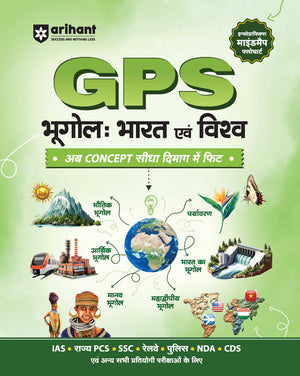
The Arihant GPS Book combines all the essential features aspirants need in one resource, with concise, scientifically designed content and one-page coverage of tough topics. It covers all General Studies subjects like History, Geography, Polity, Economy and General Studies in both Hindi and English mediums. Clear, brain-friendly mind maps it enables quick understanding and revision, helping aspirants keep their preparation efficient, focused, and easy to manage. |
Time Management Tips Using Visual Learning And UPSC Mind Maps
One of the most important aspects of UPSC preparation is time, and visual learning can help to make the most out of it.
·Revision cycles with mind maps: Replace long revision cycles with brief reviews with UPSC mind maps.
· Develop visual summaries on a daily basis: Summarise notes into mini mind maps at the end of the study session.
· Choose the high-weightage areas: Focus your Mind maps on the frequently asked questions in UPSC.
· Integrate with the active recall: Challenge yourself by recreating mind maps in memory.
· Secure weekly slots of visual revision: Have slots exclusively to revise Mind maps UPSC.
Common Mistakes To Avoid While Using Mind Maps For UPSC Preparation
While mind maps are powerful, incorrect usage can limit their effectiveness.
|
1. Making diagrams too complex: |
Incorporating excessive information complicates the process of making changes. |
|
2. Passive consumption: |
You do not have to read a Mind Map Book on UPSC passively, but actively. |
|
3. Overlooking conceptual clarity: |
Mind maps must supplement, not substitute, knowledge. |
|
4. Inconsistency: |
The selective application of UPSC mind maps diminishes their effectiveness. |
|
5. Lack of updates: |
Static mind maps that do not integrate current affairs may be outdated. |
Conclusion
You should have a feel for the relationship between various topics in order to pass the UPSC exam. Revision is the only way to secure a top rank. Arihant’s GPS Series Mind Map books simplify difficult subjects into easy-to-follow visuals. These books help you remember information longer and give you the confidence to reach your goals.
FAQs
Q1. Which Is The Best Mind Map Book To Prepare For Upsc?
Ans. The best mind maps book to prepare for UPSC is the GPS Series by Arihant Publications, which provides the perfect blueprint, gathering all essential subjects in one exam-focused resource in Hindi and English medium.
Q2. How Many Hours Do Upsc Toppers Study Daily?
Ans. Though study hours vary, many toppers usually study for around 6–8 focused hours each day. It is the consistency that matters, not like you study 14 hours one day and then take a break for 2-3 days.
Q3. Are Mind Maps Useful for UPSC?
Ans. Yes, mind maps are highly useful for UPSC preparation. They help in simplifying complex topics, organising information, and aiding memory retention.
Q4. How to prepare for GS UPSC?
Ans. Build a strong foundation with NCERT books. Join a UPSC Exam Coaching or prepare a study plan to study at home. Read newspapers for current affairs. Practice with mock tests and focus on answer writing skills.