Standard Notes Vs Mind Maps: Best Revision Method For UPSC
Introduction
Mind maps are powerful visual diagrams that organise information in a way that enhances understanding and memory retention. In UPSC preparation, where the syllabus is vast, simply studying hard is not enough; smart revision is key. Mind maps for UPSC allow aspirants to connect static subjects with dynamic current events seamlessly.
Books like Arihant GPS are specifically designed to simplify this process by presenting the entire syllabus through structured mind maps, making revision faster and more effective.
|
Table of Contents |
|
1. Introduction |
2. Why Revision Strategy Matters in UPSC Preparation? |
3. Standard Notes vs Mind Maps for UPSC: Which Revision Method Wins? |
4. Which is the best UPSC mind map book for IAS aspirants? |
5. Benefits of Using Mind Maps for UPSC Aspirants Should Know |
|
6. Conclusion |
|
7. FAQs |
Why Revision Strategy Matters In UPSC Preparation?
A strong revision strategy can make the difference between selection and rejection in UPSC.
|
Vast syllabus coverage |
· The UPSC syllabus contains a wide variety of subjects such as History, Geography, Polity, Economy, etc. · It is very difficult to remember things without revising them. |
|
Improves recall during exams |
· Planned revision will lead to faster writing of answers · Provides better understanding and assurance in Prelims and Mains |
|
Saves time in the long run |
· With the help of innovative techniques such as UPSC mind maps, students can slash their revision time to a great extent. · In addition, one can also outsmart the necessity of poring over thick volumes repeatedly. |
|
Boosts conceptual clarity |
· Revision is not a pure exercise of memory; it also fosters better comprehension. · Serves as a tool for linking dead and live topics in current affairs |
|
Essential for multiple revisions |
· UPSC requires at least 4–5 revisions · Efficient tools like a Mind Map Book for UPSC make this achievable |
Standard Notes Vs Mind Maps For UPSC: Which Revision Method Wins?
Let’s compare both approaches to understand their effectiveness:
|
STANDARD NOTES |
Mind Maps for UPSC |
|
Advantages |
Advantages |
|
· Detailed and comprehensive coverage · Ideal for first-time learning · Useful for building a conceptual foundation |
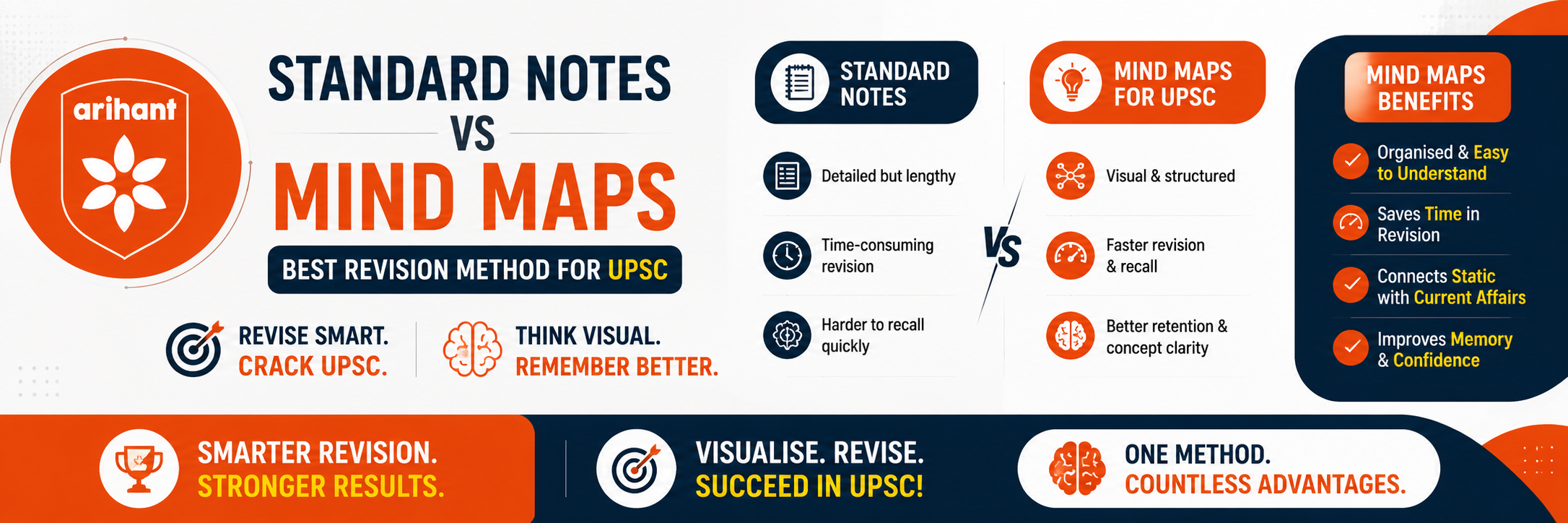
· Visual and structured representation of topics · Faster revision and recall · Helps in linking multiple concepts together · Ideal for last-minute revision |
While standard notes are useful for building conceptual understanding, they often become lengthy, time-consuming, and difficult to revise quickly before exams.
In contrast, mind maps for UPSC simplify information, enhance retention, and enable faster revision. Therefore, in today’s exam-oriented preparation, UPSC mind maps emerge as the more efficient and practical revision method.
Which Is The Best UPSC Mind Map Book For IAS Aspirants?
The GPS Book by Arihant is considered one of the best UPSC mind map books available in the market. The book combines all the essential features aspirants need in one resource, with concise, scientifically designed content and one-page coverage of tough topics. It covers all General Studies subjects like History, Geography, Polity, Economy and General Studies in both Hindi and English mediums.
Clear, brain-friendly mind maps it enables quick understanding and revision, helping aspirants keep their preparation efficient, focused, and easy to manage.
And It Also Provides Features Like:
· Concise content: Information should be short, clear, and easy to grasp.
· One-page tough topics: Complex subjects should be covered in a single-page format for quick revision.
· Scientific approach: Content should follow a structured, research-based learning method.
· Clear visuals: Well-designed Mind maps for UPSC should be clean and easy to understand.
· Quick revision friendly: Helps in revising anytime with minimal effort.
· Better retention: Visual structure in UPSC mind maps for IAS improves memory and recall.
Benefits Of Using Mind Maps For UPSC Aspirants Should Know
Mind maps are not just trendy; they are highly effective.
· UPSC mind maps offer a clear structure for fast learning
· Short notes are simple to review and update
· All General Studies topics are gathered together
· Revision becomes quicker and smarter
· Memory keeps stronger, and answers feel more natural
· Works well during final prep and focused studying
Conclusion
Instead of memorising facts, students start connecting ideas through patterns. Revision isn't just review; it's the moment theory meets real action. Mind Map Books for UPSC simplify dense topics so knowledge sticks longer without extra stress.
With the GPS Series by Arihant, everything comes together in one place. The layout turns study time into something one can follow easily. In the end, this visual format gives clarity and builds steady confidence toward the IAS goal.
FAQs
Q1. Which Mind Map Book Is Best For UPSC?
Ans. The best mind map book for UPSC is Arihant’s GPS Book Series, which brings all subjects together in one place. From History and Polity to other core areas, everything is covered through clear, well-structured, and brain-friendly mind maps that make concepts easy to understand and revision quick in the Hindi and English medium.
Q2. Why Are Mind Maps For UPSC Considered More Effective Than Traditional Linear Notes For The IAS Exam?
Ans. Mind maps use visual patterns to mirror how the brain thinks. They link subjects together, simplify the syllabus, and make revision much faster than reading dense, traditional notes.
Q3. How Many Times Should I Revise Using Mind Maps?
Ans. Revision frequency is key to success in UPSC. Ideally, you should revise at least 4–5 times, and using Mind maps UPSC makes multiple revisions faster and more efficient.
Q4. What Three Things Must A Mind Map Have?
Ans. The main idea, subject or focus is crystallised in a central image. The main themes radiate from the central image as 'branches'. The branches comprise a key image or key word drawn or printed on its associated line.