Why Solving Topic-Wise MCQs Is The Secret To Clearing UPSC Prelims On The First Attempt
Introduction
UPSC Prelims is just around the corner on 21 August, and now is not the time for passive study. This is the phase where smart preparation matters more than hard preparation. Instead of picking new sources, aspirants must focus on revision and practice.
Solving topic-wise MCQs from a reliable UPSC Objective Book can help you strengthen concepts, identify weak areas, and boost confidence before the exam.
|
Table of contents |
|
1. Introduction |
2. Why UPSC prelims demand a smart MCQ strategy? |
3. Understanding the importance of topic-wise MCQs in UPSC preparation |
4. Features of the best objective book for UPSC preparation |
5. Time management techniques while solving MCQs for prelims |
6. Common mistakes aspirants make while practising MCQs and how to avoid them |
|
7. Conclusion |
|
8. FAQs |
Why UPSC Prelims Demand A Smart MCQ Strategy?
UPSC Prelims is an objective test in which all questions challenge your clarity and decision-making.
1. Questions tend to be abstract rather than literal.
2. Options are confusing and closely related
3. Negative marking makes guessing risky
Simply reading books is not enough. You will need to train to use your knowledge with MCQs. An objective book that is good to prepare for the UPSC will help you know how questions are worded and how to be able to filter through the wrong answers.
Understanding The Importance Of Topic-Wise MCQs In UPSC Preparation
Topic-wise MCQs are one of the most effective ways to prepare.
|
· Builds strong concepts: |
When you solve questions from a single topic, your understanding becomes deeper |
|
· Improves retention: |
Repeated practice helps you remember facts and concepts for longer |
|
· Marks' weak points: |
You can understand which aspects should be revised more easily. |
|
· Builds confidence: |
Your confidence is built by progressing step by step before the exam. |
If you study Polity, then do topic-wise MCQs right away. You'll see exactly what you grasped. Top performers use top-tier MCQ books for UPSC Prelims because they test recall fast.
Features Of The Best Objective Book For UPSC Preparation
Not every MCQ book is useful. Aspirants often waste time solving random questions that are not aligned with UPSC standards. Choosing the best MCQ book for UPSC requires clarity and strategy.
Key Factors to Consider:
· Strict alignment with UPSC Prelims syllabus
· Quality of questions, not quantity
· Concept-based and analytical MCQs
· Detailed explanations for every answer
· Chapter-wise structure for systematic preparation
Best Objective Book And MCQ Book For UPSC Prelims Preparation
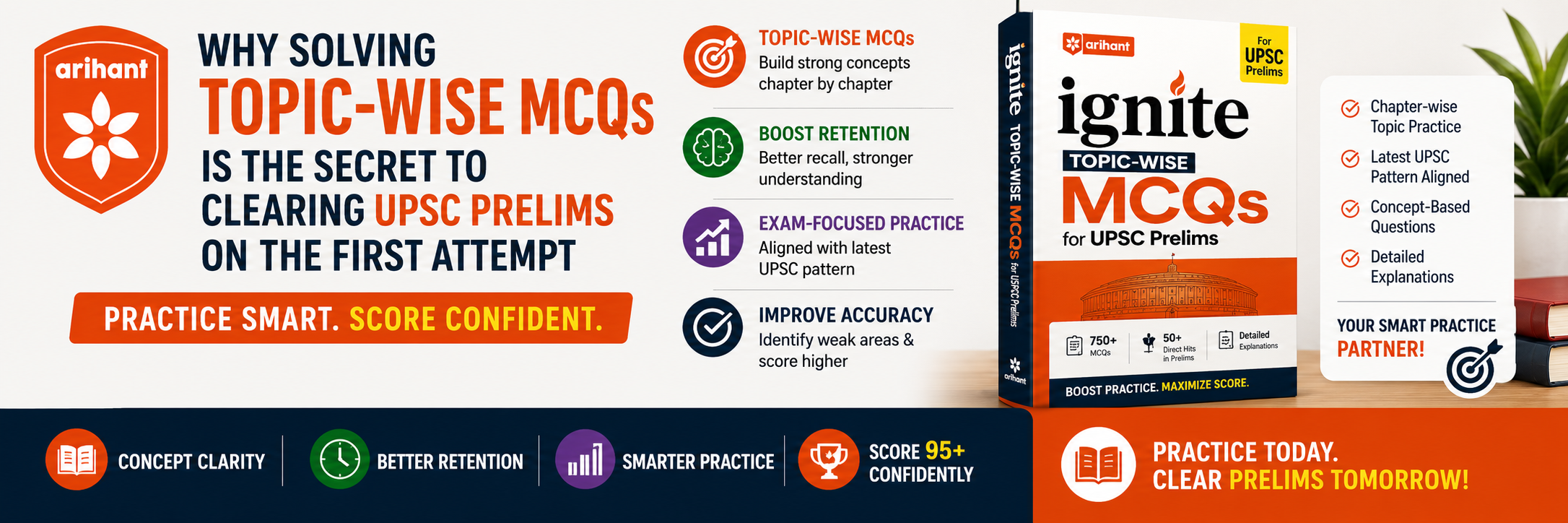
For focused Prelims practice, Arihant Ignite Topic-wise MCQs Book from art and culture to Indian history. It’s a highly useful UPSC objective book for preparation. Its topic-wise MCQ format with 750+ MCQs allows aspirants to practice questions immediately after completing each chapter, with 50+ direct hits in prelims and ensures better concept retention.
The questions are aligned with the latest UPSC trends and focus on conceptual clarity rather than rote learning. Clear and concise explanations help improve accuracy and reduce negative marking, making it one of the best MCQ books for UPSC prelims.
Time Management Techniques While Solving MCQs For Prelims
Practising MCQs without time management is not effective.
Here Are Some Simple Techniques:
|
Set a timer: |
Try solving 25–30 questions in 30 minutes |
|
Follow the 2-round strategy: |
1. First round: Solve easy and sure questions 2. Second round: Attempt tricky ones |
|
Avoid overthinking: |
If unsure, move on and come back later |
|
Analyse your performance: |
Spend time reviewing mistakes after practice |
An UPSC Objective Book will allow you to practice regularly and, with time, to increase your speed and accuracy.
Common Mistakes Aspirants Make While Practising MCQs And How To Avoid Them
The mistakes that lead to the lack of improvement among many aspirants who practice MCQs are:
1. Not paying attention to explanations: You should never ignore explanations of why an answer is right or wrong.
2. Practising randomly: Focus on topic-wise practice first, then mixed tests
3. Fail to revise errors: Have a notebook of wrong answers.
4. Guessing excessively: Learn to develop elimination skills rather than to guess blindly.
5. Reading excessive books: Use one or two of the best MCQ books to use in the Prelims in the UPSC.
These are some of the errors that you should avoid to enhance your performance.
Conclusion
Ultimately, success in the UPSC Prelims hinges on how well you can apply what you’ve learned. Ignite Topic-wise MCQs by Arihant serves as an essential bridge between theory and the final exam, offering the targeted practice and exam-aligned insights necessary to boost your score.
It is a strategic addition to any serious aspirant's toolkit.
FAQs
Q1. Is Arihant Good For UPSC?
Ans. Arihant books are generally considered good for UPSC preliminary exam preparation, but the top objective books for UPSC Prelims include Arihant's Ignite Series (1,000+ MCQs) and Manohar Pandey's Objective General Studies for comprehensive coverage available in Hindi and English medium.
Q2. How Many MCQs Should I Practice Daily For UPSC Prelims?
Ans. You should aim to solve 50–100 questions daily from a reliable UPSC Objective Book to build consistency and accuracy.
Q3. Why Is MCQ Practice Crucial For UPSC Prelims Success?
Ans. MCQ practice builds conceptual clarity, increases accuracy and prepares aspirants for UPSC’s analytical and unpredictable Prelims question pattern.
Q4. Are Prelims Only MCQ?
Ans. Yes, the UPSC Preliminary Examination is fully objective-type, based entirely on Multiple Choice Questions (MCQs).