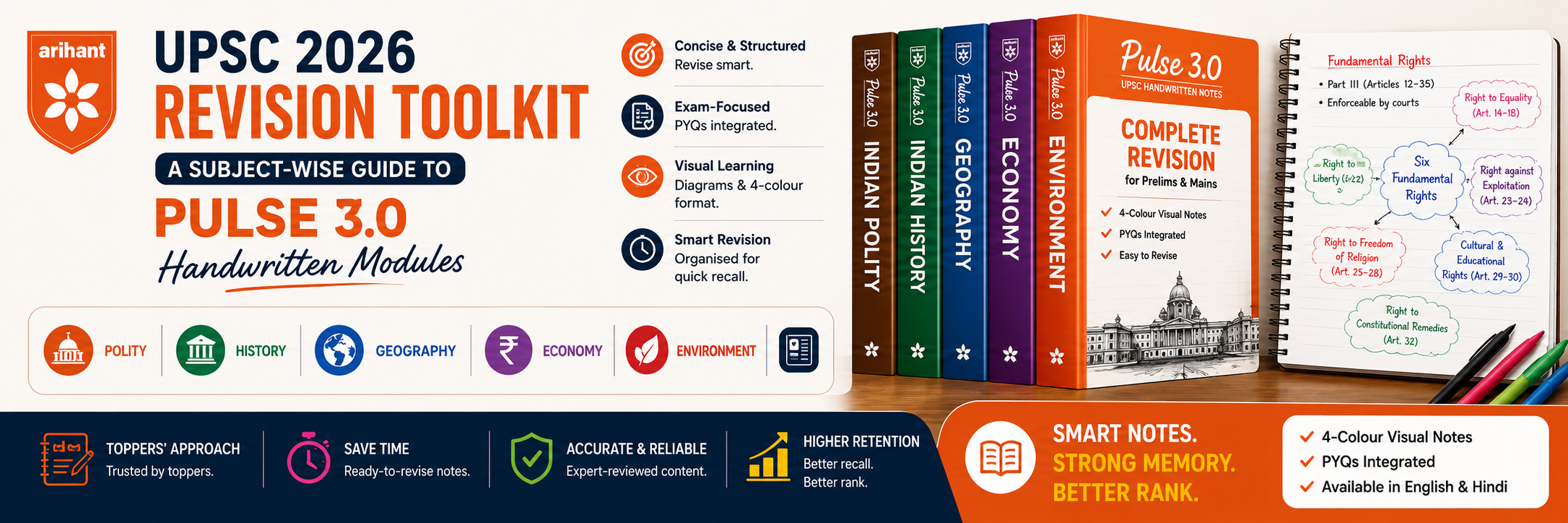
The UPSC 2026 Revision Toolkit: A Subject-Wise Guide To Pulse 3.0 Handwritten Modules
Introduction
The efficiency of the studies is equally essential to UPSC preparations as the quantity of the same. Revision becomes inefficient in case of unstructured revisions because of the amount of content to cover within the time period. Revision also does not become efficient due to the presence of multiple sources or poor-quality notes among candidates. Therefore, creating a revision technique becomes necessary.
It becomes possible to make revisions more efficiently through the use of UPSC notes that are properly structured. In place of constantly searching for sources, candidates can become more productive by following this method. It becomes imperative for candidates to create a revision technique in the latter stages of their preparation.
|
Table Of Contents |
|
1. Introduction |
|
2. What Makes a Powerful UPSC Revision Toolkit? |
|
3. Subject-Wise Breakdown Using Handwritten Modules |
|
4. How to Use Handwritten Notes for Maximum Retention |
|
5. Why Pulse 3.0 Matches Toppers’ Revision Approach |
|
6. Conclusion |
|
7. FAQs |
What Makes a Powerful UPSC Revision Toolkit?
The UPSC aspirants need a planned and deliberate approach to revision; everything that is required to revise successfully is an appropriate methodology.
· When simple revisions are involved, then the subject matter should be concise and structured.
· Revision becomes much simpler when the syllabus is broken down into small sub-topics.
· Why Flow charts and diagrams help you remember knowledge better.
· The inclusion of PYQs makes your revision more examination-oriented.
· Revision notes should be organized and not haphazard.
This knowledge can help you revise faster just before the prelims.
Subject-Wise Breakdown Using Handwritten Modules
The process of revision helps increase efficiency and avoid misinterpretations.
By revising the governance-oriented research papers, revisions, and concepts using UPSC handwritten notes, it becomes imperative when preparing for Polity. The timeframe and chronology must be constantly revised by using the help of UPSC handwritten notes. Writing UPSC maps and charts by hand will facilitate the understanding of geography.
By simplifying the concepts of economics and relating them to current affairs in handwritten notes, misinterpretations can be avoided. Revision will be done very quickly by utilizing short courses covering the static and dynamic aspects of the environment and ecosystem. For Current Affairs, the revision process should be done in a precise manner via monthly aggregates of
How To Use Handwritten Notes For Maximum Retention
Handwritten notes can be helpful when combined with proper editing processes. While reading for the very first time, one needs to make sure that they understand the concept. Highlighting the key parts becomes important in the second reading. In the third reading, it becomes essential to go through the content rapidly and keep it memorized.
Repetition and recalling help retain information well. It is also important to establish a link between the theoretical concepts and the current scenario. Revision is important as one read is not enough.
To make your time efficient while preparing for prelims, you need to focus on weightage topics and write handwritten notes for UPSC prelims. The IAS handwritten notes are useful here.
Why Pulse 3.0 Matches Toppers’ Revision Approach
|
Feature / Aspect |
How Pulse 3.0 Helps |
|
Toppers’ Approach Alignment |
Structured like UPSC toppers’ handwritten notes for better revision and retention |
|
Visual Learning |
4-colour format improves memory recall and understanding |
|
Syllabus Coverage |
Divided into micro-targets for easy tracking and completion |
|
Exam Relevance |
Integrated with PYQs to stay aligned with exam trends |
|
Content Accuracy |
Reviewed by experts to avoid missing important topics |
|
Time Efficiency |
Ready-to-revise format eliminates need to make notes from scratch |
|
Overall Utility |
Works as a complete revision toolkit, not just notes |
Conclusion
The secret behind clearing the UPSC Prelim exams is not about studying hard, but rather about revising well. A lot of revision is possible within a certain period of time with a proper revision technique, and at the same time it helps save time too. The handwritten modules of each subject make life easier for you.
Remember this: adopt a technique where revision becomes easier and quicker.
FAQs
Q1. Are Handwritten Notes Useful For UPSC Prelims?
Yes, handwritten notes are highly useful for quick revision and better retention. They help condense vast topics into manageable formats.
Q2. Should I make my own notes or use ready ones?
A combination works best—self-made notes for understanding and ready notes for revision. This approach balances clarity and efficiency.
Q3. Do toppers use handwritten notes?
Yes, many toppers rely on concise handwritten notes for revision. They focus on multiple revisions rather than bulky resources.
Q4. Which are the best handwritten notes for IAS preparation?
The best notes are concise, structured, and exam-focused. They should simplify concepts and support quick revision.