Why Your Brain Remembers Handwritten Notes Better Than Printed Textbooks
Introduction
If you are a UPSC aspirant, your room probably looks like a mini-library. Stacks of heavy Laxmikanth, Spectrum, and bulky coaching modules are everywhere. You read them for hours, highlight every second line with a neon marker, and yet, when you sit for a mock test, the brain goes blank. You know the information is there, but you can't ‘see’ it.
This is the classic ‘Printed Text Trap.’
Standard textbooks are designed for information storage, not for active recall. On the other hand, there is a reason why almost every topper, from AIR 1 to the last person on the list, swears by UPSC handwritten notes. Science proves that your brain processes handwritten strokes differently from printed blocks of text. Let’s dive into why transitioning to handwritten notes like the Pulse 3.0 series is the smartest move you can make for Prelims and Mains.
|
Table of Contents |
|
1. Introduction |
2. The Cognitive Connection: Why ‘Writing’ is ‘Wiring’ |
3. UPSC Toppers Handwritten Notes: The Secret of Visual Memory |
4. Best Handwritten Notes for IAS: Quality Over Quantity |
5. Handwritten Notes for UPSC Prelims: The 54+ Hit Strategy |
6. The ‘Panic to Strategy’ Shift |
|
7. Conclusion |
|
8. FAQs |
The Cognitive Connection: Why ‘Writing’ Is ‘Wiring’
When you read a printed textbook, your brain is in a passive state. It’s similar to watching a movie. However, when you look at handwritten notes for UPSC, your brain views the information as an ‘event’ instead of just data. Research in psychology shows that writing activates the Reticular Activating System in the brain.
This system filters what is important and what isn't. Because handwriting is slower and more intentional than typing or passive reading, your brain has more time to process the concept. This is why a complex topic like Article 356 or Plate Tectonics is easier to remember when you see it in a handwritten format with arrows and underlines.
UPSC Toppers Handwritten Notes: The Secret of Visual Memory
Have you ever wondered why the handwritten notes of UPSC toppers are so popular? It’s not just because they passed the exam; it’s because their notes are organized in a way that helps recall. Textbooks are linear, with line after line of dull black ink. Toppers’ notes, on the other hand, use Smart Frameworks.
They include margins, different ink colors, and flowcharts. Your brain has a strong ability to remember visuals. When you are in the exam hall, struggling with a question about the Permanent Settlement System, your brain won’t remember page 243 of a textbook. It will remember that specific handwritten flowchart you saw in your notes.
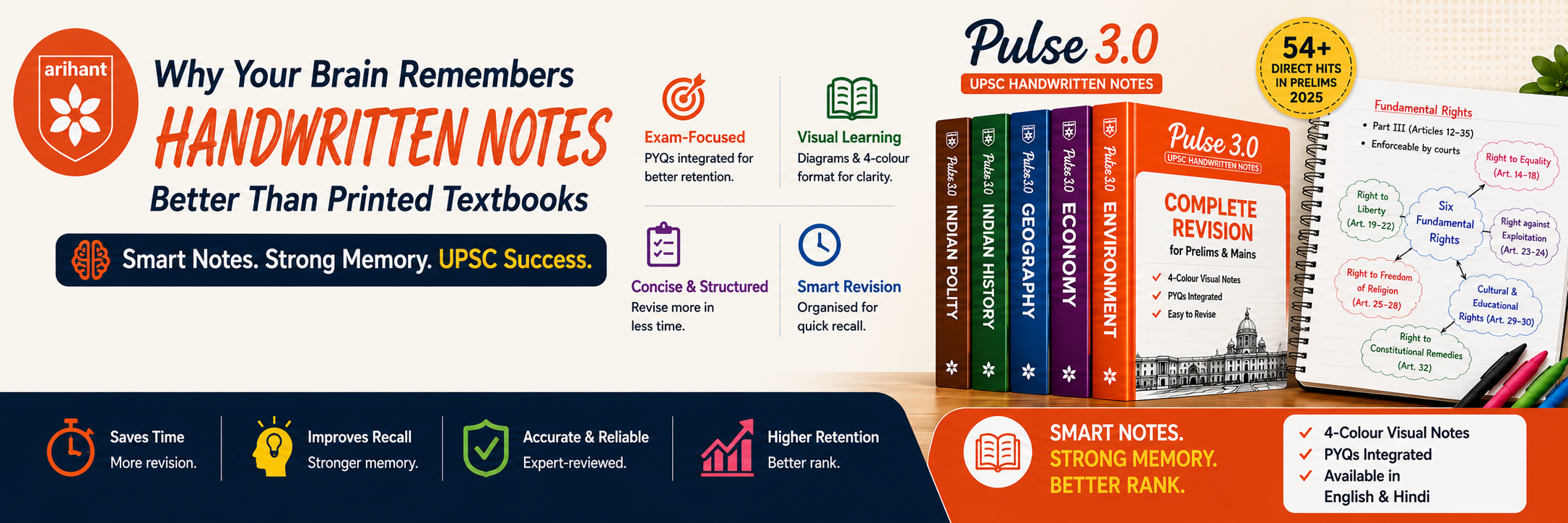
This is the idea behind Pulse 3.0. We took the best parts of handwritten notes from UPSC toppers and turned them into a colorful visual guide. It reflects the way a topper’s brain naturally organizes information.
Best Handwritten Notes for IAS: Quality Over Quantity
In the UPSC journey, ‘Less is More.’ A common mistake is trying to read 10 different books for one subject. The best handwritten notes for IAS are those that combine 5 sources onto one page. Printed books often have extra text, including introductory sentences and unnecessary information that isn’t relevant to the exam.
Handwritten notes focus on what you need to know. They provide the essential content of the topic. When you use IAS handwritten notes, you are essentially reading a filtered version of the syllabus. This helps you save time, lessen mental fatigue, and increase how often you revise.
Handwritten Notes for UPSC Prelims: The 54+ Hit Strategy
Prelims is a game of elimination and ‘Smart Guessing.’ You need to have facts at your fingertips. Handwritten notes for UPSC prelims are designed for high-speed scanning.
In the 2025 Prelims, the Pulse series saw 54+ questions coming directly from its content. Why? Because these notes don't just give you information; they give you ‘Memory Hooks.’ Whether it’s a map of National Parks or a table of Mughal Administration, the handwritten format ensures that the data ‘sticks.’
The ‘Panic to Strategy’ Shift
As the exam date gets closer, ‘Endless Syllabus’ leads to ‘High Panic.’ Printed textbooks look like mountains you can't climb. Toppers' handwritten notes UPSC look like a roadmap you can follow.
The Pulse 3.0 series is designed to act as your ‘Ultimate Revision Partner.’ It replaces the messy, unorganized notes you tried to make yourself with professionally curated, exam-ready notes.
Why Pulse 3.0 Is The Choice Of Serious Aspirants:
· 4-Color Visuals: To trigger the brain's color-coding memory.
· SMART Framework: To track your syllabus progress (Syllabus tracker, Mind sparks, Author connect, Revision through PYQs, Targeted videos).
· PYQ Integrated: Every note is linked to what UPSC actually asks.
Conclusion
The UPSC exam doesn't just test your knowledge; it tests your retention. You can read 1,000 pages, but if you can't recall 10 points in the exam hall, it’s all in vain.
Transitioning from bulky printed modules to high-quality UPSC handwritten notes is like upgrading from a cycle to a sports car. It’s faster, more efficient, and designed for the finish line. Don't let your hard work get lost in the ‘messy texts’ of old-school books. Give your brain the visual edge it needs.
Pulse 3.0 is not just a book; it’s a strategy. Grab your set today and turn your panic into a Prelims-ready performance.
FAQs
Q1: Can I Rely Solely On Handwritten Notes For UPSC?
A: While basic concepts should be understood from standard sources, for revision and high-yield topics, UPSC toppers handwritten notes like Pulse 3.0 are sufficient and highly effective for Prelims.
Q2: Why is Pulse 3.0 called ‘Handwritten’ if it’s a published book?
A: It is curated by experts in a handwritten font and layout to mimic the way human brains process visual information. It includes diagrams, flowcharts, and annotations that you won't find in a standard printed textbook.
Q3: How do these notes help in last-minute revision?
A: Because they are revision-oriented, you can scan a 20-page chapter in just 15 minutes. The 4-color visuals help you ‘photograph’ the page in your mind.
Q4: Are these notes available in both Hindi and English?
A: Absolutely. Pulse 3.0 is available across all major subjects in both languages to help every aspirant excel.