Handwritten Notes Vs Printed Material: What Works Better For UPSC Aspirants
Introduction
With the UPSC Prelims only 4 to 5 months away, the pressure is real. This isn't just any exam; it’s one of the toughest in the world, requiring laser-like focus. Many aspirants spend months drowning in a sea of books, switching from one "best seller" to another, hoping to find that one magic source. This "resource trap" leads to confusion and wasted time.
If you want to hit your dream score and clear the cutoff, you need to stop collecting books and start consolidating your knowledge. UPSC handwritten notes are the only tool that can save you from end-of-moment panic.
|
Table of Content |
|
1. Introduction |
2. Why do most UPSC toppers prefer handwritten notes over printed study material? |
3. Smart use of handwritten notes for UPSC prelims |
4. How to make effective handwritten notes for UPSC & IAS? |
5. Which features define the best handwritten notes for IAS aspirants? |
6. Common mistakes aspirants make while preparing handwritten notes |
|
7. Conclusion |
|
8. FAQs |
Why Do Most UPSC Toppers Prefer Handwritten Notes Over Printed Study Material?
You might have seen toppers' handwritten notes for UPSC shared online. Why do they spend hours writing when they could just buy a printed summary? Here is why:
1. Better Memory Power: Science says that when you write by hand, your brain is more active. The physical act of moving a pen helps you remember facts much longer than just clicking a mouse or highlighting a page.
2. Speed During Mains: The UPSC Mains exam requires you to write for 6 hours a day. Making IAS handwritten notes trains your hand muscles and improves your writing speed and handwriting from day one.
3. Personalisation: Printed books are made for everyone. But your notes are made just for you. You can skip the parts you already know and focus deeply on the topics you find difficult.
4. Ease of Revision: You cannot revise a 500-page book two days before the exam. But you can easily revise 20 pages of handwritten notes of UPSC toppers' style summaries.
Smart Use Of Handwritten Notes For UPSC Prelims
Prelims demand clarity, speed, and accuracy. Reading multiple books again and again is not practical. This is where handwritten notes for UPSC prelims become extremely useful.
Smart Usage Includes:
1. Making topic-wise notes (Polity, Economy, Environment, etc.)
2. Adding current affairs updates to static notes
3. Using keywords, flowcharts, and short points
4. Revising notes weekly instead of revising books
Instead of memorising facts from printed material repeatedly, aspirants who rely on UPSC handwritten notes can recall concepts faster during the exam.
How To Make Effective Handwritten Notes For UPSC & IAS?
Making notes is an art, and doing it the wrong way can waste time. Follow these simple steps to create effective handwritten notes for UPSC:
|
Step 1: Read First, Write Later |
Never start writing directly. Read from standard books or reliable sources first. |
|
Step 2: Write in Your Own Words |
Avoid copying lines. Use simple language that you understand easily. |
|
Step 3: Be Brief |
One topic should ideally fit into 2–3 pages. Quality matters more than quantity. |
|
Step 4: Use Diagrams and Flowcharts |
Visual representation improves understanding, especially in subjects like Geography and Polity. |
|
Step 5: Leave Space for Updates |
The UPSC syllabus is dynamic. Always keep space to add current affairs. |
Well-structured IAS handwritten notes save a significant amount of revision time before the mains and prelims.
Which Features Define The Best Handwritten Notes For IAS Aspirants?
Not all notes are useful. The best handwritten notes for IAS aspirants share some common features:
1. Syllabus-aligned, topic-wise structure for focused UPSC prelims preparation
2. Short, handwritten explanations covering high-yield and overlooked areas
3. Integrated topic-wise PYQs for better revision and accuracy
4. Structured framework reflecting guided and exam-oriented learning
5. Strong conceptual clarity with analytical focus for tricky questions
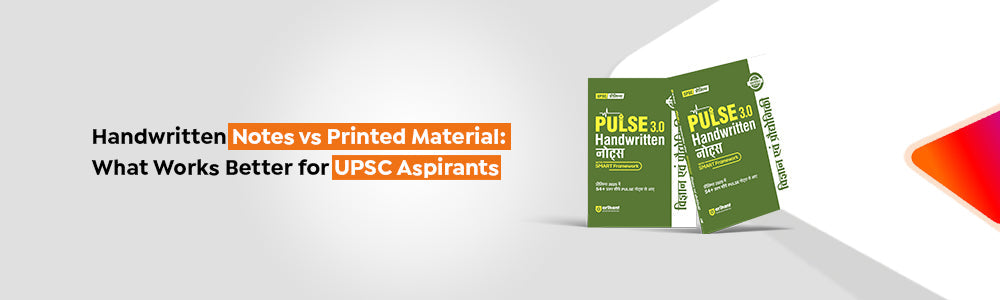
Many UPSC aspirants struggle to choose the right book due to its bulky content, poor syllabus linkage, and difficulty in last-minute revision, which often leads to confusion and the need for multiple sources. Pulse 3.0 Handwritten Notes with Smart Framework by Arihant Publications addresses this issue by offering syllabus-aligned, crisp handwritten notes focused on high-yield areas, along with topic-wise PYQs for effective revision.
Its structured and exam-oriented approach helps aspirants save time, reduce source overload, and prepare more confidently for UPSC prelims.
Common Mistakes Aspirants Make While Preparing Handwritten Notes
While handwritten notes are powerful, many aspirants misuse them. Some common mistakes include:
1. Making notes from every source
2. Writing everything without filtering
3. Rewriting printed material word by word
4. Making notes too bulky
5. Not revising notes regularly
Remember, handwritten notes are meant to reduce content, not increase it. Too many notebooks can become a burden rather than a support.
Conclusion
In the final stage of UPSC preparation, what truly matters is clarity, confidence, and quick revision. While books help build concepts, success is driven by notes that help you retain, revise, and recall under pressure. This is exactly where Pulse 3.0 Handwritten Notes with Smart Framework by Arihant Publications stands out by offering focused, syllabus-driven, and revision-ready content trusted by serious aspirants.
FAQs
Q1. What Are The Key Differences Between Handwritten Notes And Printed Material?
Ans. Handwritten notes are concise and personalised, while printed material is detailed but often bulky and time-consuming to revise.
Q2. Which Format Supports Better Conceptual Clarity For Upsc Preparation?
Ans. Handwritten notes offer better conceptual clarity as they are written in one’s own words and focused on exam needs.
Q3. How Does Active Learning Differ Between Handwritten And Printed Notes?
Ans. Handwritten notes promote active learning through thinking and summarising, whereas printed notes involve passive reading.
Q4. Can Both Handwritten And Printed Materials Be Used Together Effectively?
Ans. Yes, printed material helps build concepts, while handwritten notes are best for revision and retention.