Visual Mastery: How to Use UPSC Mind Maps to Connect Static UPSC & Dynamic Topics
Introduction
A mind map is a diagram used to visually organise information, making it much easier to understand and recall.
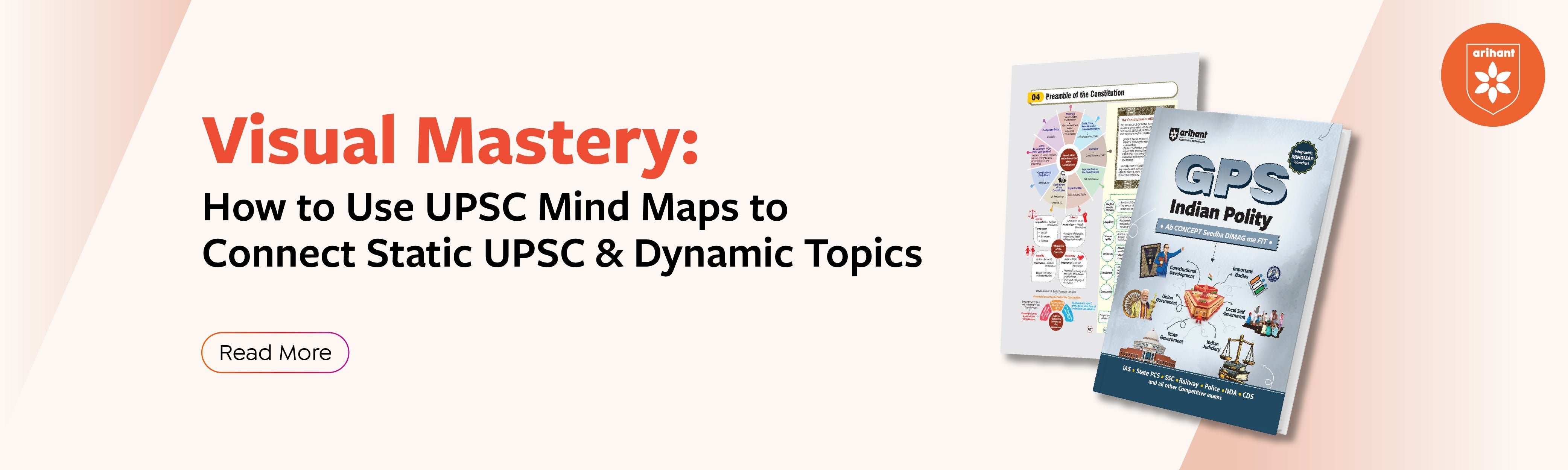
Most UPSC aspirants work incredibly hard, but the real winners are those who work smartly by linking static subjects to dynamic daily events. UPSC mind maps help you navigate through a massive amount of data without losing focus. By using these maps, you can bridge the gap between textbook theory and current affairs, which is the key to scoring high. If you want to streamline your studies, the GPS books are designed to help you by covering the full syllabus through professional mind maps, providing a clear route to exam success.
|
Table of Contents |
|
Introduction |
How to use UPSC mind maps to connect static & dynamic topics? |
Benefits of using Mind Maps for UPSC |
Who should use a mind map book for UPSC? |
Which is the best UPSC mind map book for IAS aspirants? |
|
Conclusion |
|
FAQs |
How To Use UPSC Mind Maps To Connect Static & Dynamic Topics?
In the UPSC exam, you get higher marks when you show how different subjects are connected. Using mind maps for UPSC makes this easy. Here is the best way to do it:
· The Center Anchor: Start by putting a basic topic in the middle of your page
· Static Branches: Draw lines to show the fixed rules, like Article 356 or the roles of the State and Center. These are the facts that don't change often.
· Dynamic Branches: This is the most important part. Create branches for "Recent News." If there is a dispute between a Governor and a Chief Minister in the news today, link it directly to the static rules you just wrote.
· Keyword Linking: Avoid writing long sentences. Use short keywords. Instead of a paragraph on a new environment report. This keeps your map clean and easy to read.
By using UPSC mind maps, you stop treating subjects like separate files. You start seeing the "Big Picture," which is exactly what the examiners are looking for in your answer sheet.
Benefits Of Using Mind Maps For UPSC
Writing notes line-by-line in a notebook is a slow and old-fashioned way to study. It often makes it hard to find information later. Mind maps for UPSC exam preparation offer a much more modern and effective approach:
Major Benefits Include:
|
Lower Brain Stress: |
When you turn 50 pages of a textbook into one single page of a mind map, your brain feels less overwhelmed. It makes a huge syllabus look manageable. |
|
Better Memory |
The human brain remembers shapes, colours, and positions better than plain black-and-white text. |
|
Super-Fast Revision: |
You cannot read your heavy textbooks a few days before the exam. However, you can look at 50 mind maps in a few hours. A high-quality Mind Map Book for UPSC is the best tool for last-minute revision. |
|
Better Answer Structure: |
UPSC answers need to be organised. Since mind maps are already broken down into points and sub-points, they naturally train your brain to write better, more organised answers |
Who Should Use A Mind Map Book For UPSC?
While every student can benefit, certain people will find a Mind Map Book for UPSC life-changing:
· Working Professionals: If you have a full-time job and you don't have time to write long notes. You need a "shortcut" that gives you the best information quickly.
· Beginners: If you are just starting, the syllabus can be scary. UPSC Mind Maps for IAS provide a clear map so you know exactly what to study and how topics are related.
· Visual Learners: Many people find it hard to read long chapters, but can understand a diagram instantly.
· Advanced Students: Even if you have finished the syllabus, you need a way to bring all your knowledge together. Mind maps help you "connect the dots" between different subjects like Economics and Social Issues.
Which Is The Best UPSC Mind Map Book For IAS Aspirants?
The Best UPSC Mind Map Book is one that covers the entire syllabus comprehensively, presents content in a clean and exam-oriented format, and aligns with UPSC trends. A good Book for Mind Maps for UPSC should include:
· Presents the complete syllabus through clear, topic-wise mind maps for quick understanding
· Helps concepts click at one glance, reducing dependence on bulky texts
· Enables fast and effective revision anytime, anywhere
· Uses brain-friendly visuals, flowcharts, and infographics to boost retention
· Follows a scientific learning approach that strengthens memory
· Acts as a smart visual tool to keep tough concepts fixed in the mind
Now, aspirants no longer need to search multiple places for the best mind maps for different subjects, because Arihant’s GPS Book Series brings all subjects together in one place. From History and Polity to other core areas, everything is covered through clear, well-structured, and brain-friendly mind maps that make concepts easy to understand and revision quick.
This all-in-one approach solves common student problems like scattered resources, confusion, and lack of revision time, making the Arihant GPS book a complete and reliable solution for competitive exam preparation.
Conclusion
To win in the UPSC exam, you must master the art of connecting the dots. Strong revision is the bridge between a dream and a rank. Using Mind Map Books for UPSC helps you simplify complex topics and retain them longer.
The GPS Series by Arihant Publications provides the perfect blueprint, gathering all essential subjects in one exam-focused resource. With these clear visuals, you can revise with total confidence and move one step closer to your IAS goal every single day.
FAQs
Q1. Why Are Mind Maps For Upsc Considered More Effective Than Traditional Linear Notes For The Ias Exam?
Ans. Mind maps use visual patterns to mirror how the brain thinks. They link subjects together, simplify the syllabus, and make revision much faster than reading dense, traditional notes.
Q2. How Do I Integrate Daily Current Affairs Into My Existing Upsc Mind Maps?
Ans. Leave margins or use sticky notes on your maps. When news breaks, draw a new branch from the static topic to connect the update to the core theory.
Q3. Can Mind Mapping Help In Brainstorming Points For The Upsc Essay Paper?
Ans. Yes. A quick map helps you visualise social, economic, and political angles. This ensures your essay is well-structured and covers all perspectives before you begin writing.
Q4. Is It Better To Draw Mind Maps By Hand Or Use Digital Software For Ias Preparation?
Ans. Hand-drawing improves memory, while digital is easier to edit. Many toppers use the GPS Book as a professional base to save time and ensure exam-level accuracy.