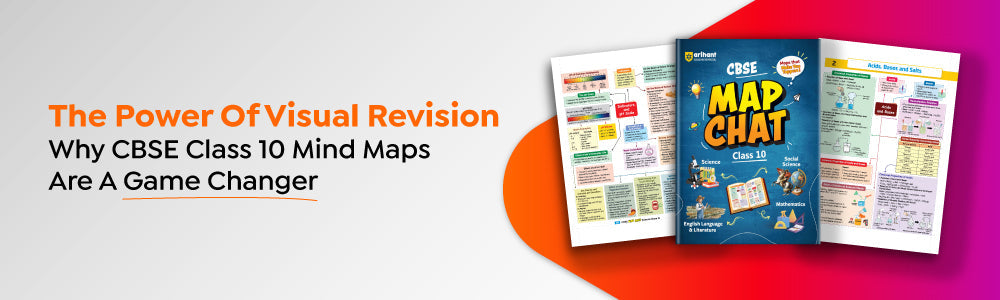
The Power Of Visual Revision: Why CBSE Class 10 Mind Maps Are A Game Changer
Introduction
As the CBSE Class 10 board exams draw closer, the pressure is mounting. Students are under pressure and are looking for quick and easy ways to understand tough chapters. At this critical hour, your focus shouldn't just be on reading more; it should be on revising smarter. This is where visual mapping becomes your greatest asset. Mind maps are the ultimate tool for this "crunch time" because they bridge the gap between heavy textbooks and quick memory recall.
In this blog, we will explain why this simple tool is a total game-changer for your studies.
|
Table of Contents |
|
1. Introduction |
2. Why CBSE class 10 mind maps are a game-changer? |
3. What are the benefits of using CBSE class 10 mind maps for exam preparation? |
4. How to use CBSE class 10 mind maps for quick revision before exams? |
5. Mind maps vs Traditional notes: Which is more effective? |
|
6. Conclusion |
|
7. FAQs |
Why CBSE Class 10 Mind Maps Are A Game-Changer?
CBSE Class 10 mind maps are a game-changer because they align with the way our brain naturally works. The human brain remembers images, colours, keywords, and connections better than long paragraphs.
Instead of reading pages of theory, a mind map presents the entire chapter on one or two pages using branches, keywords, formulas, dates, and flow connections. This makes learning less stressful and more effective.
For example:
1. A mind map for Class 10 CBSE Maths shows formulas, theorems, and steps in a single view.
2. A mind map for Class 10 CBSE Science connects concepts, reactions, diagrams, and definitions logically.
3. A mind map for Class 10 CBSE Social Science helps remember timelines, maps, causes, and effects.
What Are The Benefits Of Using CBSE Class 10 Mind Maps For Exam Preparation?
Using mind maps isn't just a fun way to draw; it actually helps you learn faster. Here is why every topper recommends them:
1. You Remember More: When you use colours and shapes, your brain creates a "mental snapshot." This makes it much easier to remember a mind map for class 10 CBSE social science during the exam because you can literally see the map in your head.
2. Saves a Lot of Time: You can’t read a 40-page chapter on the morning of an exam. But you can look at one mind map and revise the entire chapter in 2 minutes.
3. Organised Thinking: It helps you sort out the mess in your head. You know exactly what the main points are and what the smaller details are.
How To Use CBSE Class 10 Mind Maps For Quick Revision Before Exams?
Using mind maps correctly is as important as having them. Here’s a simple and effective strategy student can follow:
|
Step 1: Start with the Middle Topic |
Write the chapter name in the middle and create branches for main headings. |
|
Step 2: Use Keywords, Not Sentences |
Mind maps work best when they contain short words, formulas, dates, and pointers. |
|
Step 3: Add Colours & Symbols |
Use different colours for definitions, formulas, examples, and exceptions. |
|
Step 4: Revise Daily |
Spend 15–20 minutes every day revising 3–4 mind maps instead of rereading textbooks. |
|
Step 5: Last-Day Revision Tool |
One day before the exam, revise only the CBSE Class 10 Mind Maps to refresh the entire syllabus quickly. |
Mind Maps VS Traditional Notes: Which Is More Effective?
Traditional notes are detailed, but they are time-consuming to revise. Mind maps, on the other hand, are compact, visual, and exam-oriented.
|
Traditional notes |
CBSE Class 10 Mind Maps |
|
Used for general learning or brainstorming |
Designed specifically for Class 10 board exam revision |
|
May not strictly follow NCERT |
Fully aligned with NCERT chapters and exam pattern |
|
Includes broad or mixed information |
Covers only important and high-weightage points |
|
Takes more time to revise |
Allows quick, last-minute revision |
|
Depends on how the map is created |
Structured to simplify complex Class 10 concepts |
With Arihant’s CBSE Class 10 Map Chat, students have access to everything needed for revision in one book. It covers Science, Social Science, Mathematics, and English, so there is no need to make heavy notes or search for study material in many places. The chapters are explained through clear, NCERT-based mind maps that focus only on important exam points.
This makes revision fast, concepts clear, and recall easy during exams. It is an ideal book for stress-free, last-minute revision.
Conclusion
With very little time left for exams, students need smart revision, not bulky notes or multiple resources. CBSE map chat for class 10 by Arihant Publications offers exactly that, clear, NCERT-aligned mind maps for Science, Social Science, Mathematics, and English in one place. It helps students revise the full syllabus quickly, avoid confusion, and stay confident during exams. For last-minute preparation and strong concept clarity, this book is a reliable and complete revision solution for Class 10 board aspirants.
FAQs
Q1. How Do CBSE Class 10 Mind Maps Help In Retaining Information Longer Compared To Traditional Reading?
Ans. They turn text into pictures Since the brain remembers visuals better than words, you recall concepts faster and keep them in your memory longer.
Q2. Can I Use Mind Maps For Subjects That Are Theory-Heavy, Like Social Science And English?
Ans. Yes! They are perfect for simplifying long chapters, connecting character traits, or organizing historical dates into a single, easy-to-read page.
Q3. Is It Better To Create My Own Mind Maps Or Use Expert-Verified Ones?
Ans. Both! Making your own helps you learn, while expert maps ensure you cover all important CBSE board exam keywords and topics correctly.
Q4. At What Point In The Study Cycle Should I Start Using Visual Mapping?
Ans. Start right after reading a chapter. Use them to summarize your notes first, then use them for all your quick revisions before exams.