The Science Of Memory: Why IAS Handwritten Notes Beat Digital PDFs For UPSC Rank-Holders
Introduction
UPSC preparation requires remembering a large amount of information. While many aspirants use digital PDFs, they often do not help in long-term memory retention.
This is why UPSC handwritten notes remain important for many rank-holders. Writing by hand improves understanding and recall. Many aspirants also rely on UPSC toppers handwritten notes because they are short, structured, and useful for quick revision.
|
Table of Contents |
|
1. Introduction |
2. The science of memory and why UPSC handwritten notes still matter? |
3. How the brain remembers better with handwritten notes for UPSC? |
4. The structure and style of handwritten notes of UPSC toppers |
5. How to choose the best handwritten notes for revision? |
6. Common mistakes aspirants make while preparing handwritten notes for UPSC |
|
7. Conclusion |
|
8. FAQs |
The Science Of Memory And Why UPSC Handwritten Notes Still Matter?
Memory is enhanced by the active processing of information by the brain rather than by reading it passively. Even when you are reading a PDF, you tend to scan the information without really engaging the brain.
Written notes are better to memorize than to memorize hand notes since more mental activities are engaged.
The Reason Why Handwritten Notes Are Better.
· Writing involves the use of various constituents of the brain that are connected with learning and memory.
· Writing requires the deeper processing of information in the brain.
· Handwriting makes you slower and comprehend the concepts.
· Writing motivates to summaries rather than copy.
· This is the reason why most candidates would rather use handwritten notes when writing about the UPSC rather than using the digital resources.
How The Brain Remembers Better With Handwritten Notes For UPSC?
When you write things down in your own style, it helps your brain turn information into something you truly understand. We call this active learning.
1. Writing notes by hand for the UPSC prelims just helps your brain remember things more easily.
2. We’ll understand things better, when you write, you have to read things, think them over, and then sum them up. This makes things clearer to understand.
3. Our memories will be more connected. Writing by hand actually makes your brain connections stronger. This helps you remember things better for the test.
4. Quicker fixes your notes are just the important stuff: This helps you save time when you're checking things over.
5. Learning that adapts to you: your notes reflect your own thoughts and way of doing things. This helps make studying a bit simpler and more pleasant.
That's why a lot of people getting ready for these exams use handwritten notes to quickly review important stuff right before the prelims and mains.
The Structure And Style Of Handwritten Notes Of UPSC Toppers
The biggest benefit of handwritten notes is the simplicity and clarity of UPSC toppers notes. These are usually concise notes, revised according to subject and examination syllabus.
UPSC Toppers Handwritten Notes Often Have These Features.
· Bullet points replacing long paragraphs.
· Clear subheadings and headings.
· Diagrams, flowcharts and maps.
· Keywords to be revised.
How To Choose The Best Handwritten Notes For Revision?
Not all notes are useful. The best handwritten notes for IAS aspirants share some common features:
1. Syllabus-aligned, topic-wise structure for focused UPSC prelims preparation
2. Short, handwritten explanations covering high-yield and overlooked areas
3. Integrated topic-wise PYQs for better revision and accuracy
4. Structured framework reflecting guided and exam-oriented learning
5. Strong conceptual clarity with analytical focus for tricky questions
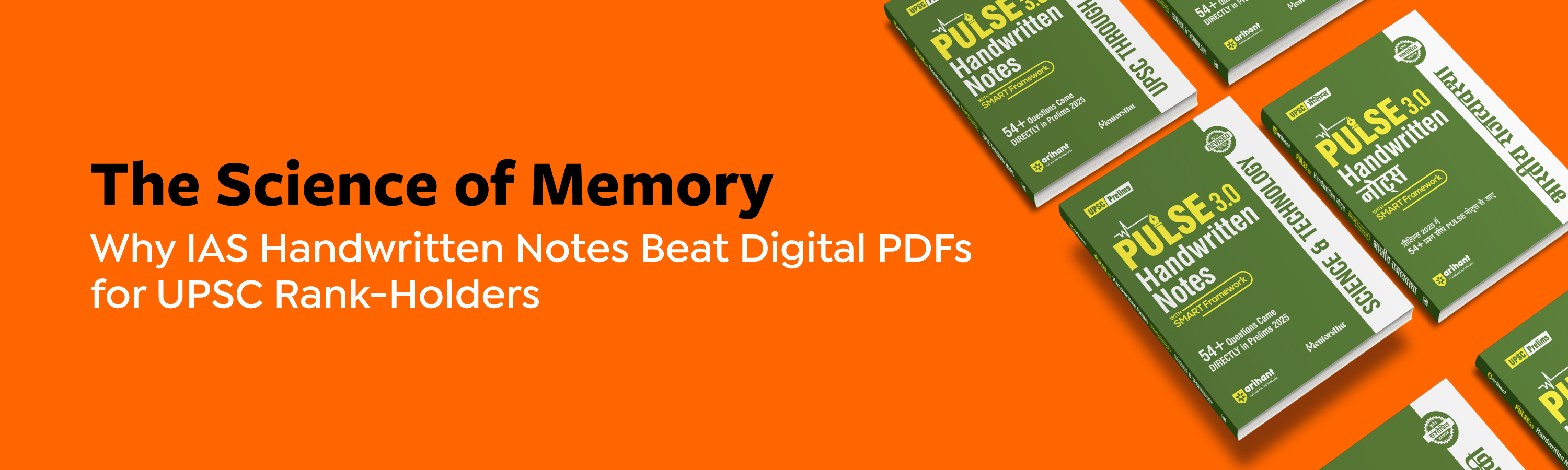
Many UPSC aspirants struggle to choose the right book due to its bulky content, poor syllabus linkage, and difficulty in last-minute revision, which often leads to confusion and the need for multiple sources. Pulse 3.0 Handwritten Notes with Smart Framework by Arihant Publications addresses this issue by offering syllabus-aligned, crisp handwritten notes focused on high-yield areas, along with topic-wise PYQs for effective revision.
Its structured and exam-oriented approach helps aspirants save time, reduce source overload, and prepare more confidently for UPSC prelims
Common Mistakes Aspirants Make While Preparing Handwritten Notes For UPSC
Good notes fail even in case revision errors are repeated.
Avoid These Common Errors:
· Making many notes and not revising a set of notes.
· Continuous revision of adding new content.
· Oversight of the practice of writing answers.
· Revising in an indeterminate manner.
· Wasting time in areas of strength.
Note, revision is not making things comfortable, it is strengthening weak areas.
Conclusion
The final stage of UPSC preparation requires students to develop three essential qualities which include their ability to understand concepts and build self-assurance and conduct fast reviews of their studies. The books assist students in developing their understanding of concepts which results in their success when they use notes that enable them to remember and study and retrieve information during challenging situations.
The Pulse 3.0 Handwritten Notes with Smart Framework from Arihant Publications delivers specialized learning materials that dedicated students trust because they provide complete study resources which match their exam requirements in Hindi and English medium.
FAQs
Q1. Why Is Notes-Making Important For UPSC?
Ans. The benefit of notes-making is that it helps condense and organize large amounts of information from multiple sources.
Q2. Is Note-Making Necessary For UPSC?
Ans. Retention and Revision: Note-making for UPSC acts as a condensed version of the extensive syllabus. Creating concise notes helps you break down complex concepts, making them easier to retain and revise.
Q3. Which Is The Best Handwritten Notes Book For UPSC?
Ans. Pulse 3.0 Handwritten Notes with Smart Framework by Arihant Publications is the best book offering syllabus-aligned, crisp handwritten notes focused on high-yield areas, along with topic-wise PYQs for effective revision in Hindi and English medium.
Q4. What Are The Benefits Of Short Notes For UPSC?
Ans. Short notes help candidates to perform revision in a better way. Instead of reading the whole book, they can focus on vital information provided in short notes.